
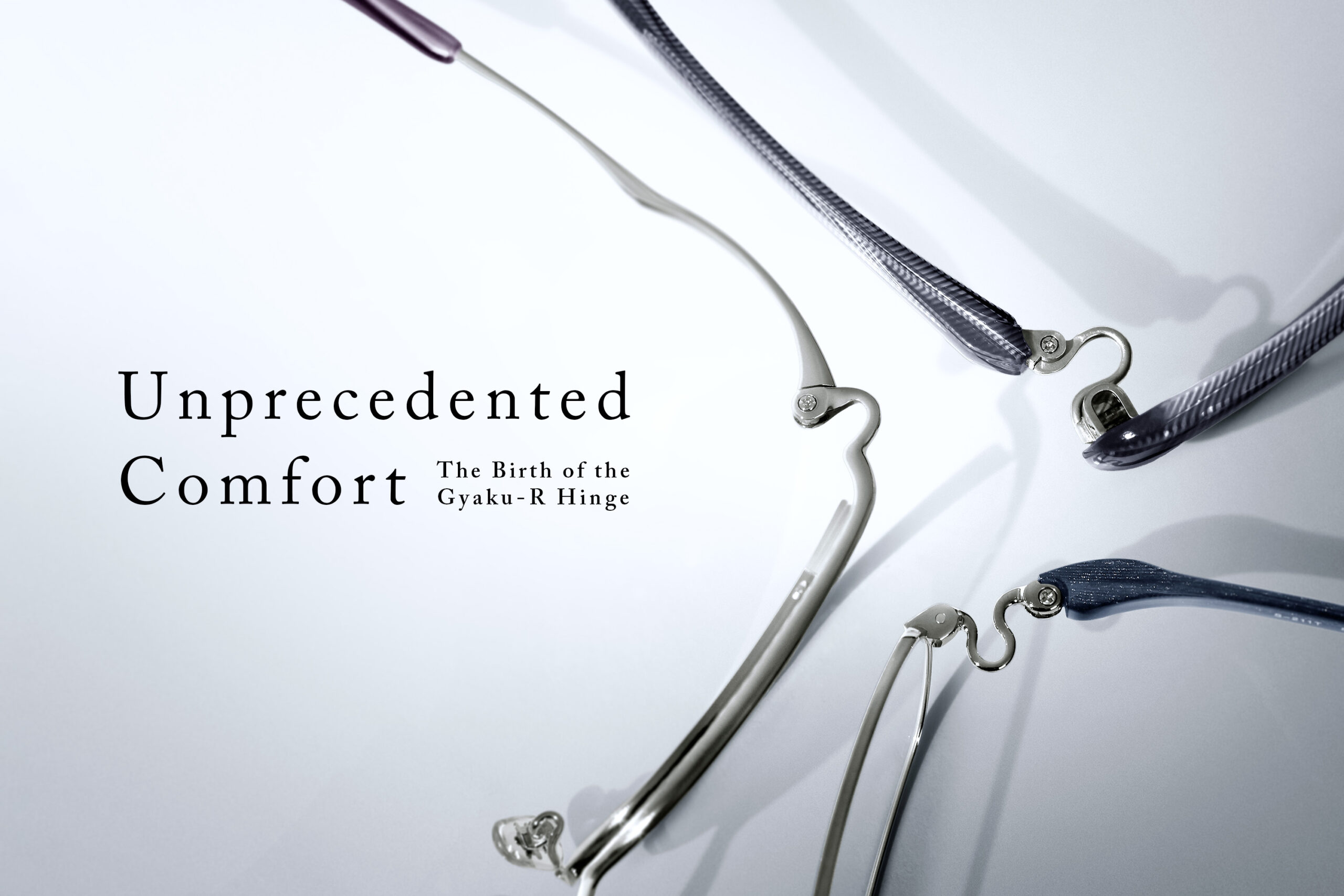
“Every time you put your glasses on or take them off, stress is placed on the temples, causing them to widen. What if reducing this strain could enhance durability and improve comfort?”
From that single observation, an ingenious mechanism was born — one that would change a fundamental norm in the eyewear industry. In 1996, one year after the founding of Four Nines, the first breakthrough invention emerged from that very philosophy. That invention was the ” R Hinge.”
The R Hinge — an idea that changed the direction of force.
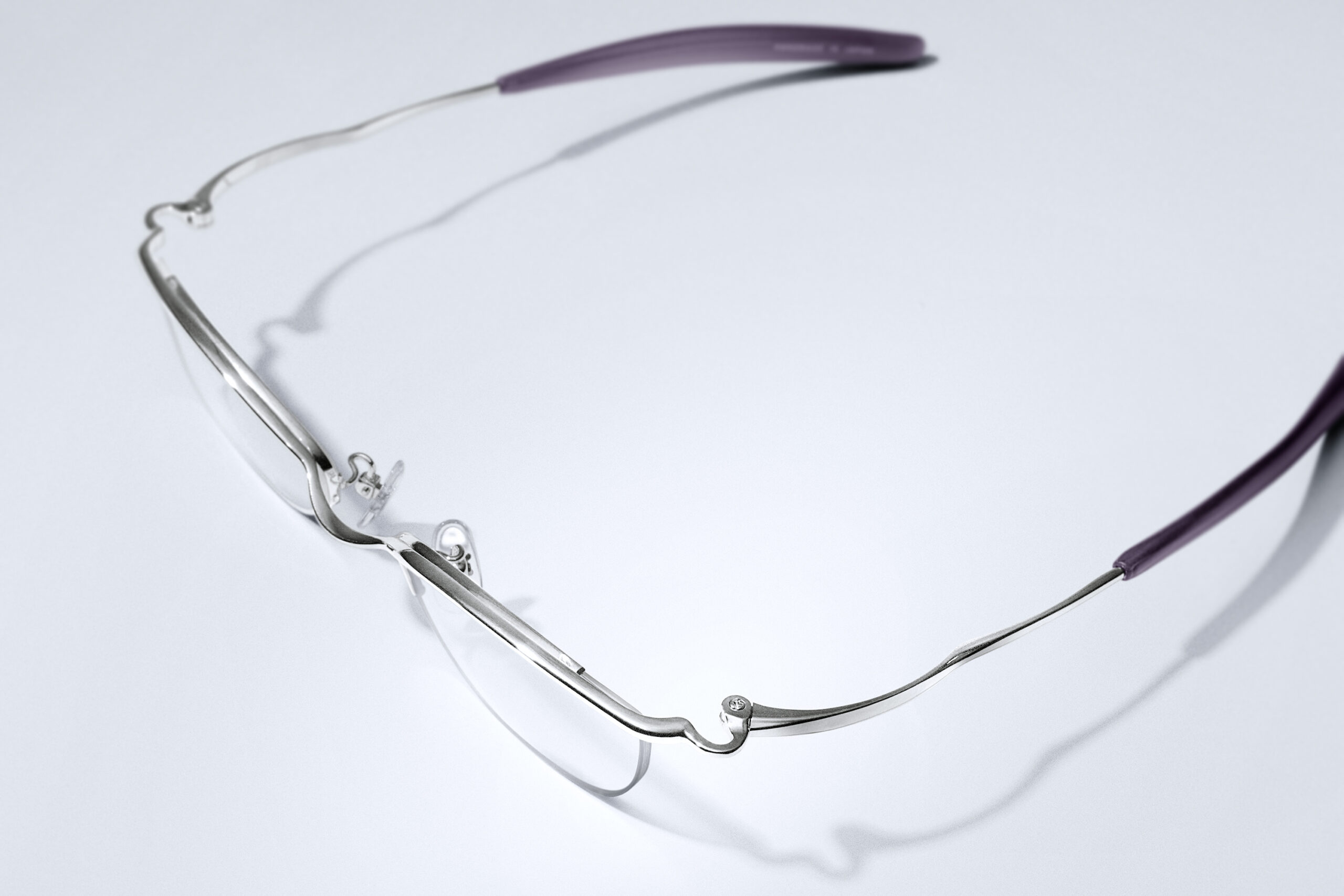
The R Hinge — an idea that changed the direction of force. Its design was simple yet revolutionary: by bending and integrating a component between the frame front and the temple, the distance between them was extended. The concept was to space apart the point where stress concentrates — from around the tip of the temple, which is pushed outward when force is applied, all the way to the front of the frame — thereby reducing the strain on the frame itself. Initially, its unprecedented and distinctive shape left many customers uncertain. However, by explaining the reasoning behind its shape and the philosophy driving the design of the frame, it gradually gained acceptance — and even shared appreciation. People came to understand: this shape was not arbitrary; it was the direct result of a single-minded pursuit of function.
Not long after, a new challenge emerged. When putting the glasses on or taking them off, the temples were pulled outward. However, if they were to snag or if excessive force was applied, there now existed a possibility that they would simply keep bending outward.
The Gyaku-R Hinge — a true reversal of thinking.
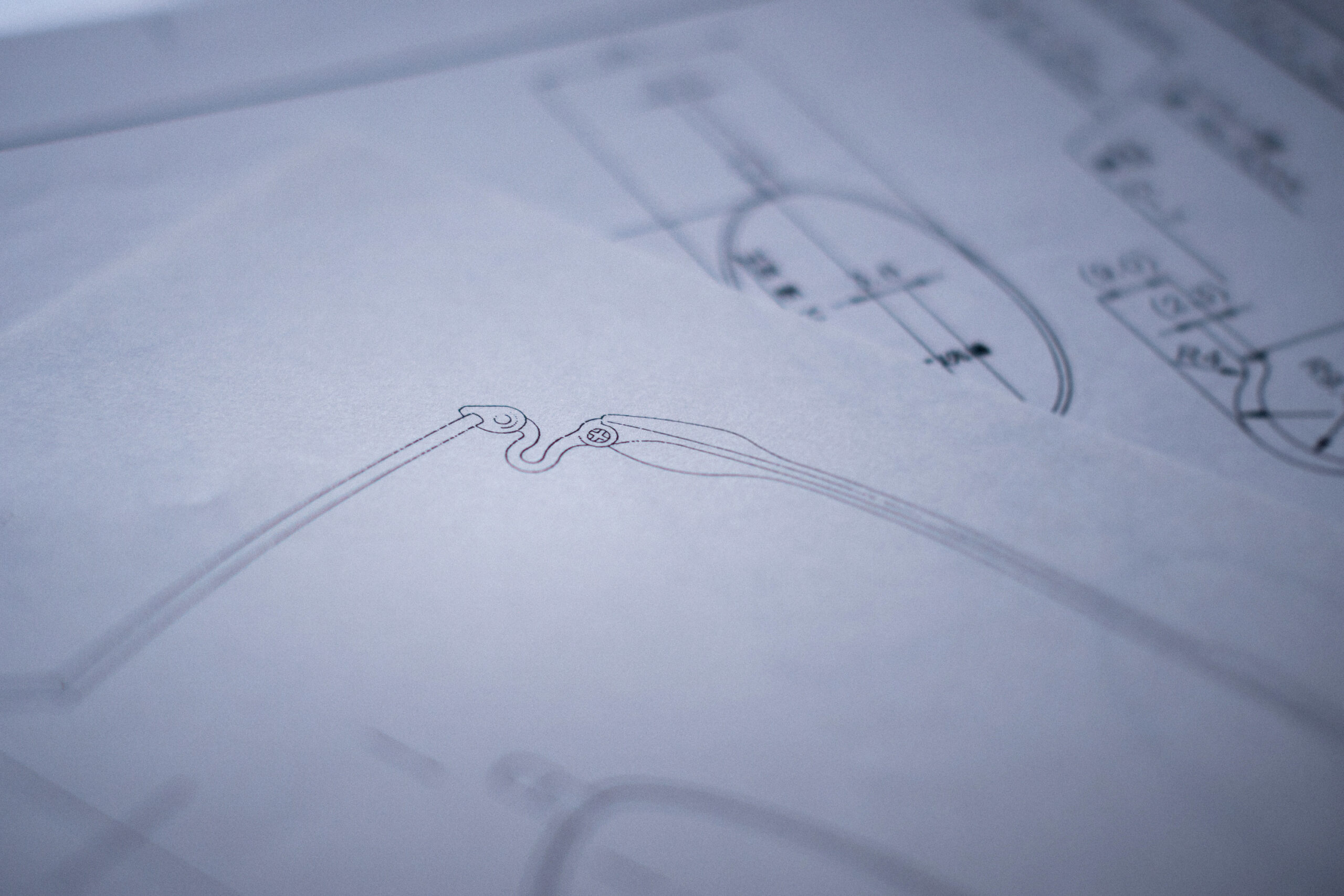
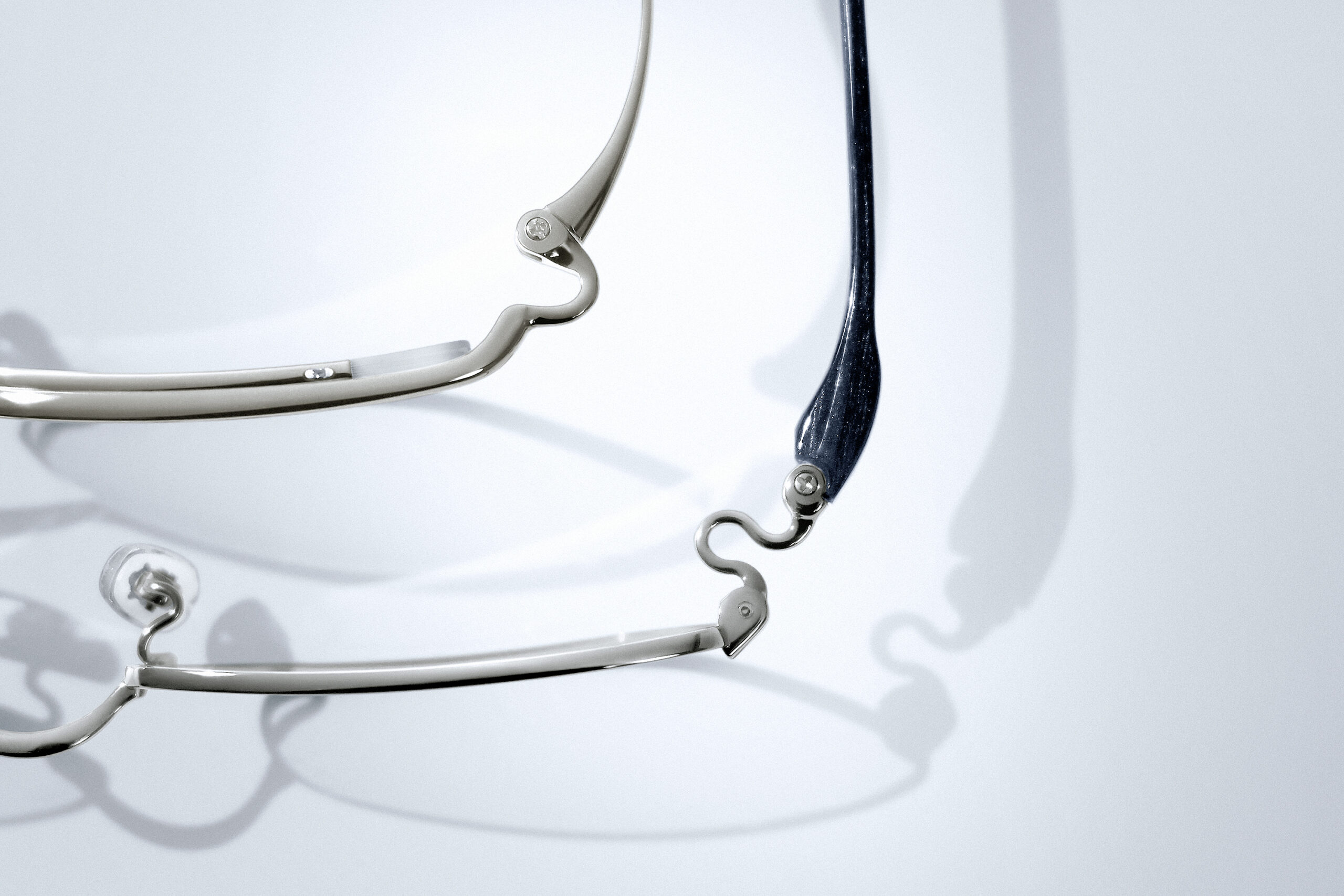
“wait, …isn’t it inverted?”
By bending the hinge inward, a natural limit was created. Even if the temples are pulled outward with extreme force, the endpiece and the joint of the temple would meet, preventing over-expansion and improving durability. More importantly, it made adjusting width and tilt remarkably easier. This was the precise moment the “Gyaku-R Hinge” was born.
In the year 2000, Four Nines introduced the “Gyaku-R Hinge” to the world. It was made of pure titanium. The following year, in 2001, Four Nines adopted a super elastic titanium alloy with greater flexibility. By 2003, its form had also evolved, transitioning from a cylindrical shape to a flat one. Simultaneously, the very role of the Gyaku-R Hinge evolved — from “creating distance to the point of stress” to “flexibly articulating and absorbing pressure.”
The Gyaku-R delivers a fit so natural you forget you’re wearing glasses — a feeling unprecedented in conventional eyewear. Combined with remarkable freedom of adjustment and enhanced durability, it embodies the philosophy behind Four Nines design: “comfortable,” “durable,” and “easy to adjust. “Thus, the Gyaku-R Hinge became the single mechanism that achieves all three of the core values Four Nines upholds.
The Challenge of Plastic Frames

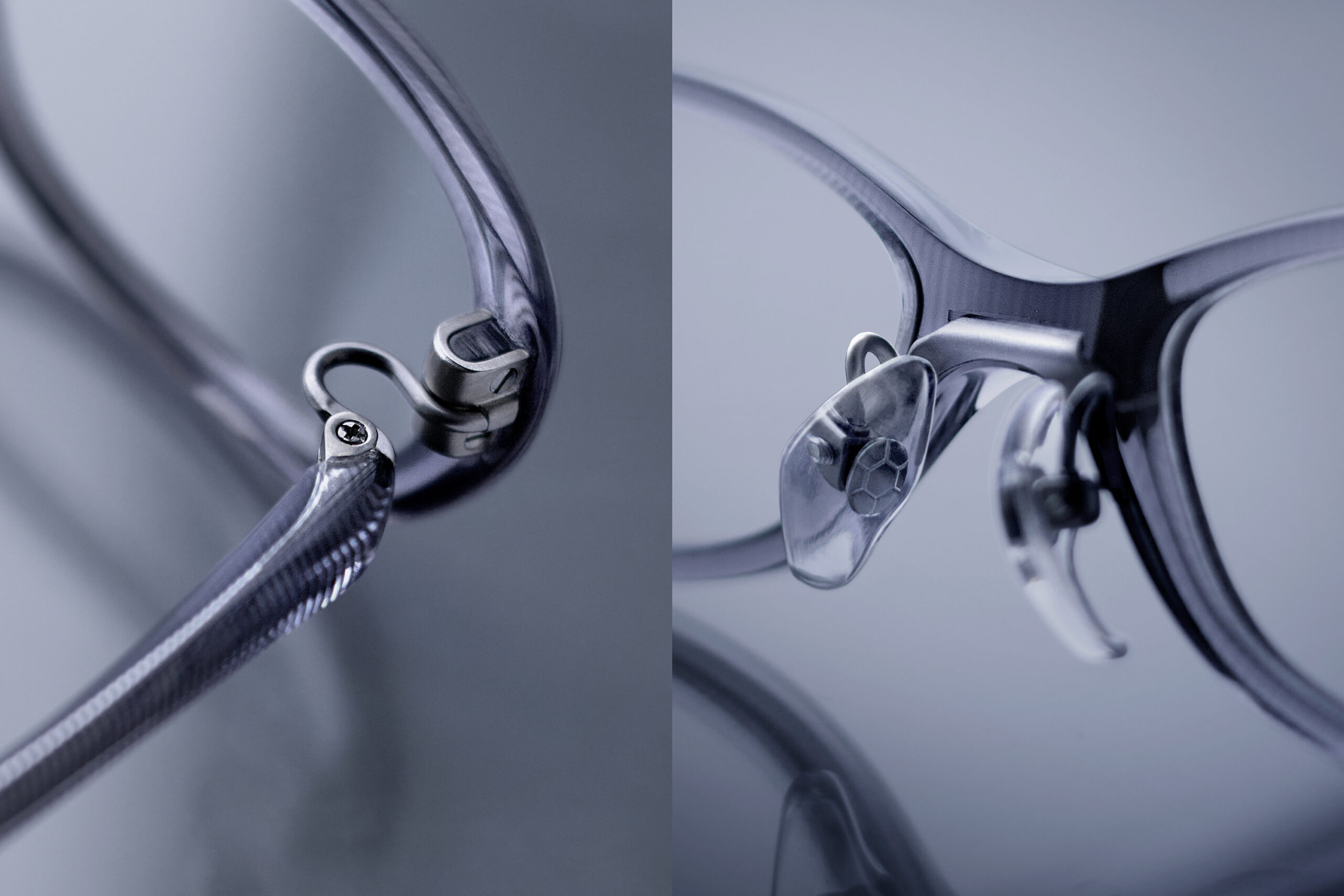
The early 2000s was the peak era for plastic frames, with eyewear retailers of all kinds surging into the market. Faced with this trend, Four Nines set itself a new challenge: to create a different kind of value for the plastic frame. The company was ready for its next endeavor.
Until then, typical plastic frames followed a simple structure: a front with hinges, and the temples. Compared to metal frames, their adjustability was limited, and they were prone to losing their shape. To fit a wearer’s face, adjustments often involved heating and bending or filing down the joint — processes that could significantly alter the frame’s original shape, all in pursuit of comfort. Conversely, it was also common to prioritize design, leaving the wearer to settle for an uncomfortable fit.
Four Nines set out to defy that norm. The challenge was to integrate the Gyaku-R Hinge and nose pad arms — originally designed for metal frames—into a plastic frame.
The factories turned down the quest multiple times, stating, “We can’t achieve the required precision with materials of different strengths like titanium and plastic.” Yet, Four Nines refused to give up. For the docking section where the Gyaku-R Hinge meets the frame front, the company adopted a design that sandwiches the plastic with metal. Furthermore, while plastic frames typically use material around 6mm thick, it ensured strength by milling the part from a 10mm thick plate. As for the metal nose pad arms, it chose a screw-fastening method rather than embedding them, so that in the unlikely event of damage, the parts could be replaced.
In 2003, Four Nines introduced the “Neo Plastic Frame,” a new category designed to overcome the inherent weakness of conventional plastic frames while delivering the same comfort and adjustability as metal frames. This marked the moment when the pursuit of the highest purity opened up new possibilities for plastic eyewear.
Refusing to settle, the pursuit moved toward a more natural and beautiful design
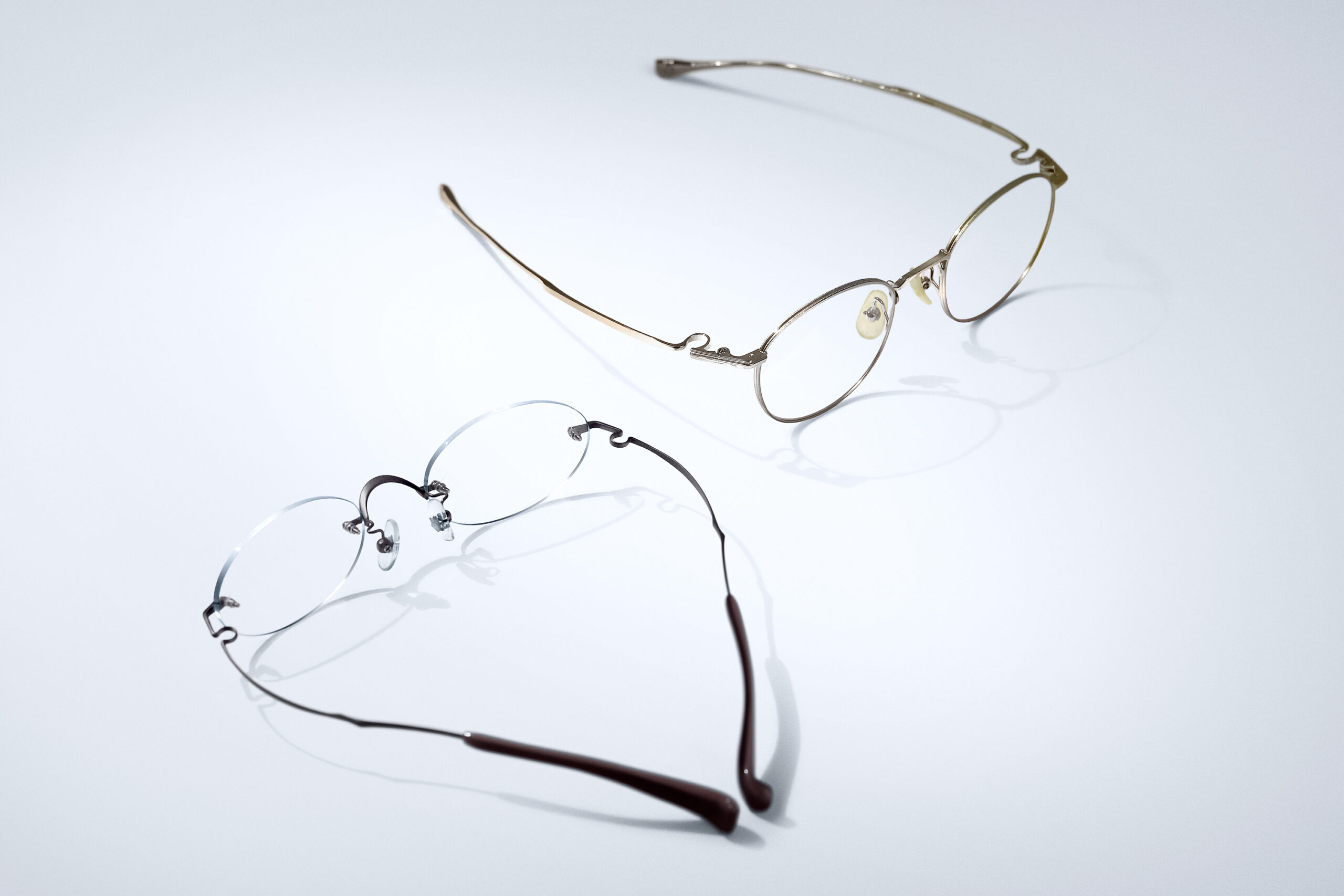
In 2002, the “Gyaku-R Temple” was created by integrating the Gyaku-R Hinge — traditionally constructed as a separate component — directly into the temple.
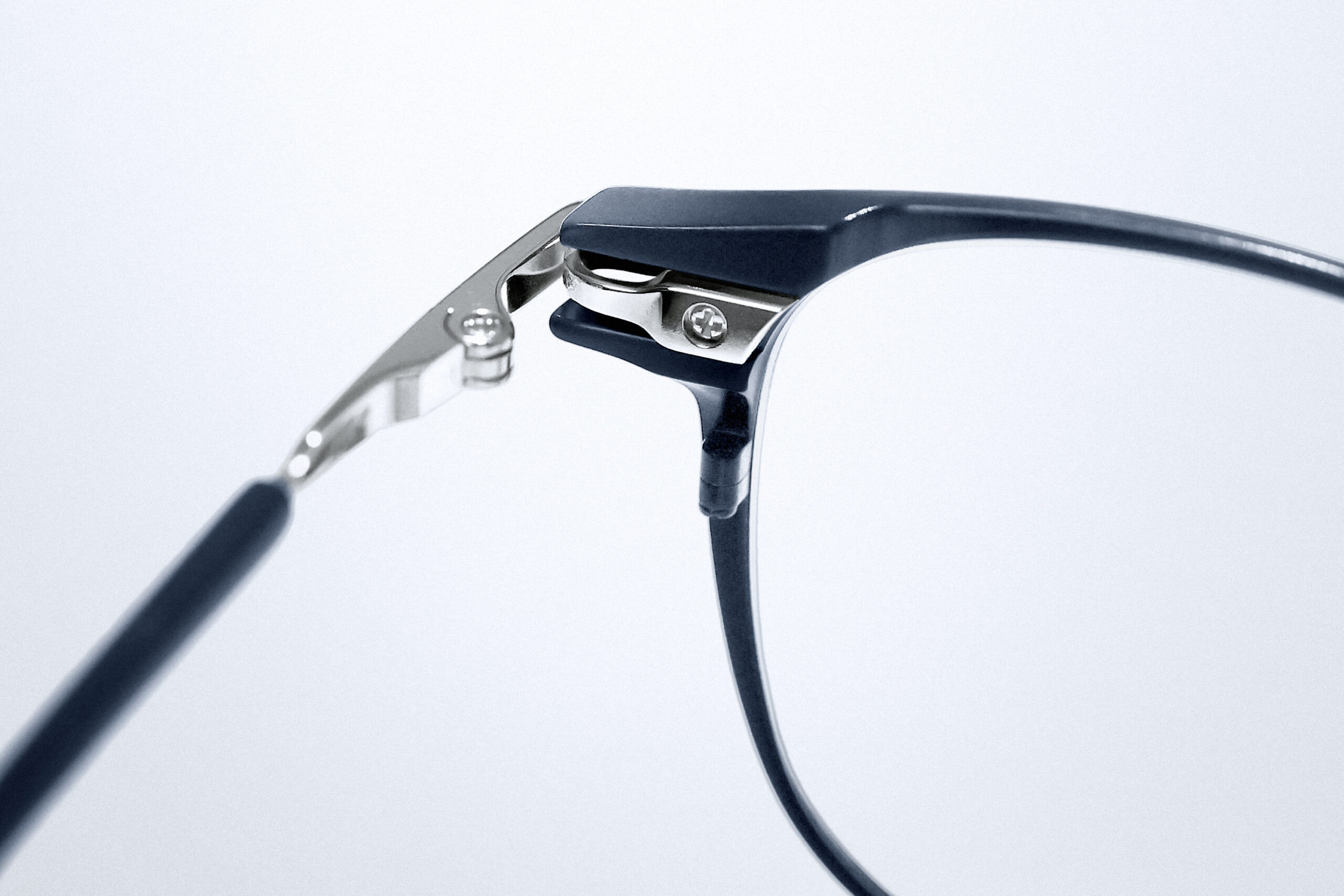
In 2016, the “Built-in Structure” was introduced. The Gyaku-R Hinge — by then an integral part of Four Nines’ identity — was concealed within the endpiece, deliberately kept out of sight. When the Gyaku-R Hinge is integrated into the frame, a gap inevitably forms between the front and the temple. Yet Four Nines refuses to accept this inevitability as a given. As comfort has become an unquestioned expectation in eyewear, the expression of the mechanisms that create this comfort continues to diversify, alongside the pursuit of new, design-driven approaches. This very approach embodies Four Nines’ attitude of engaging sincerely with customers and continually striving for improvement.
A philosophy embodied in detail
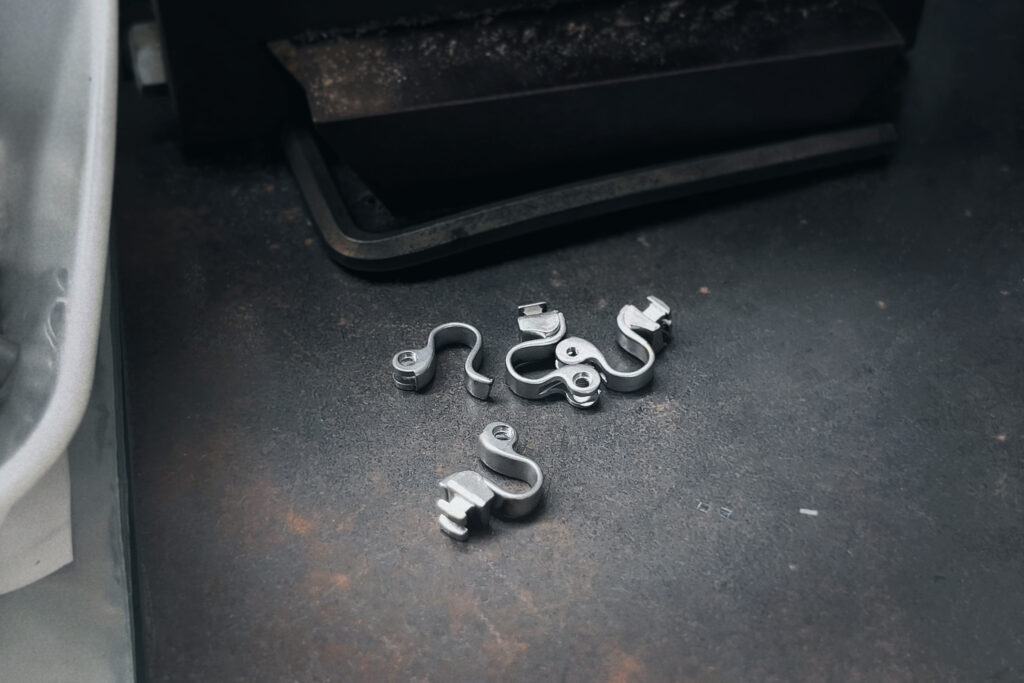
The process of realizing the Gyaku-R Hinge would not be possible without co-creation with the craftsmen at the factory.
To allow it to perform fully as a functional component, the Gyaku-R Hinge is formed through press processing. While press forming is generally carried out either vertically or from the side, the Gyaku-R Hinge is pressed laterally to draw out the material’s inherent flexibility. When eyewear is worn, the temples are constantly pushed outward. What matters, then, is the horizontal force that enables the temples to return smoothly and precisely to their original position.
From a straight, cylindrical shape, the component is gradually formed through multiple stages of press processing. For example, creating the Gyaku-R temple described earlier requires more than ten separate press operations from the side, each with its own set of dies. Of course, if efficiency alone were the goal, it would be far simpler to bend the material into an R shape from the outset and press it from above and below. But Four Nines does not choose that path. By considering the direction in which each part is meant to move, and by investing time without compromise, Four Nines remains committed to a method that ensures both flexibility and durability.
A philosophy embodied in a single invention.
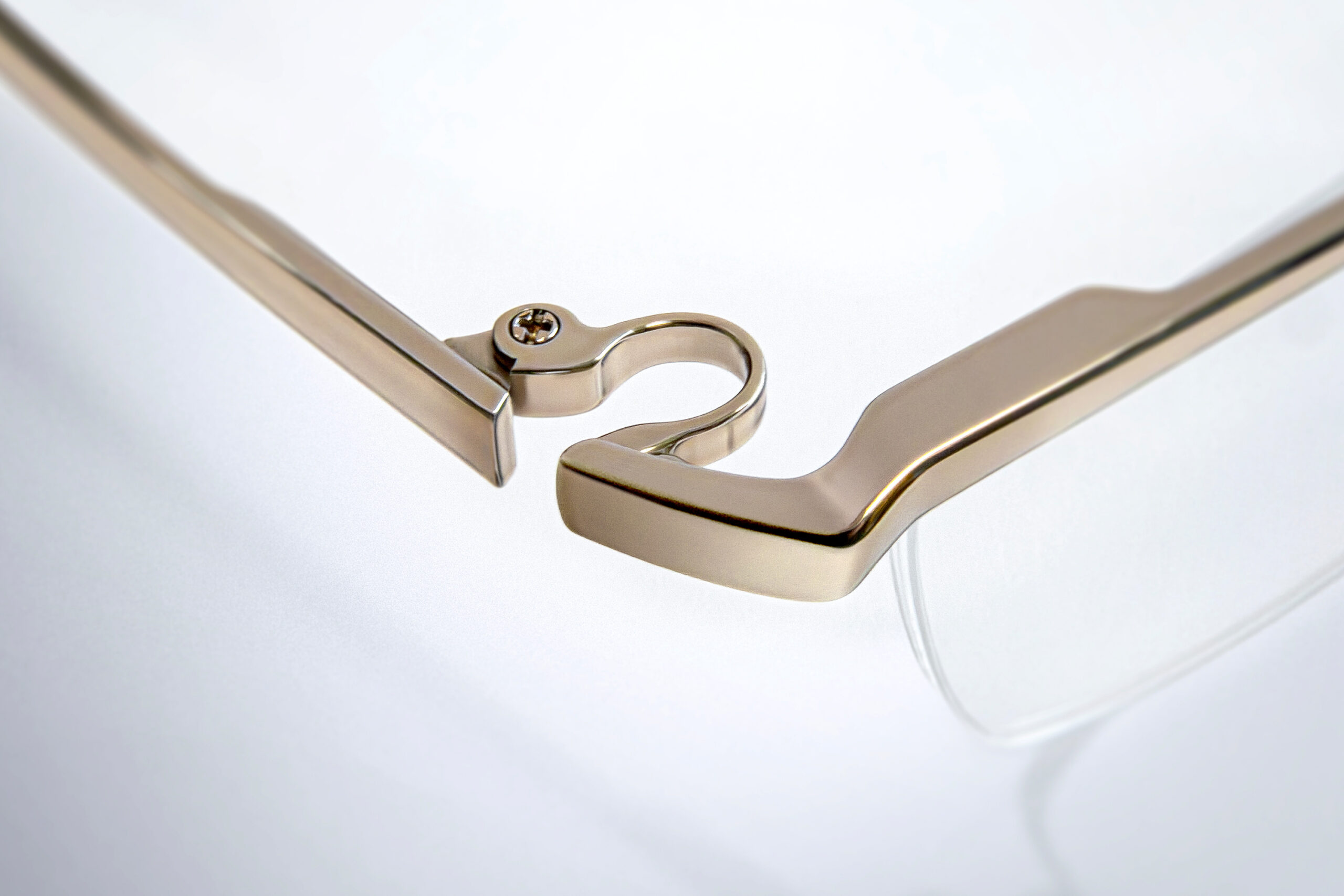
The founding question —”Was there no eyewear truly suited to the skull of the Japanese face?”— was not simply about product improvement, but about confronting the very essence of what eyewear should be. That way of thinking began with the design of the E-01, evolved through the creation of the R Hinge, and ultimately led to the Gyaku-R Hinge. More than a mechanism, the Gyaku-R Hinge stands as a symbol of what Four Nines values and how it approaches the act of creating.
Yet Four Nines’ pursuit of the highest purity does not end with this mechanism alone. The same philosophy runs through countless details — often difficult to see, yet decisive in shaping comfort. Guided by this way of thinking, Four Nines has continued to create a diverse range of models in response to changing times and the evolving needs of their customers.
Next, we will delve into this commitment to detail.
Related articles
vol.1 999.9(Four Nines) The Beginning of an Endless Pursuit
vol.2 Unprecedented Comfort: The Birth of the Gyaku-R Hinge
vol.3 Attention to Detail. Everything for Comfort
vol.4 What Makes a “Good Pair of Glasses” — Three Elements That Make It Possible
vol.5 What Glasses Bring Together